
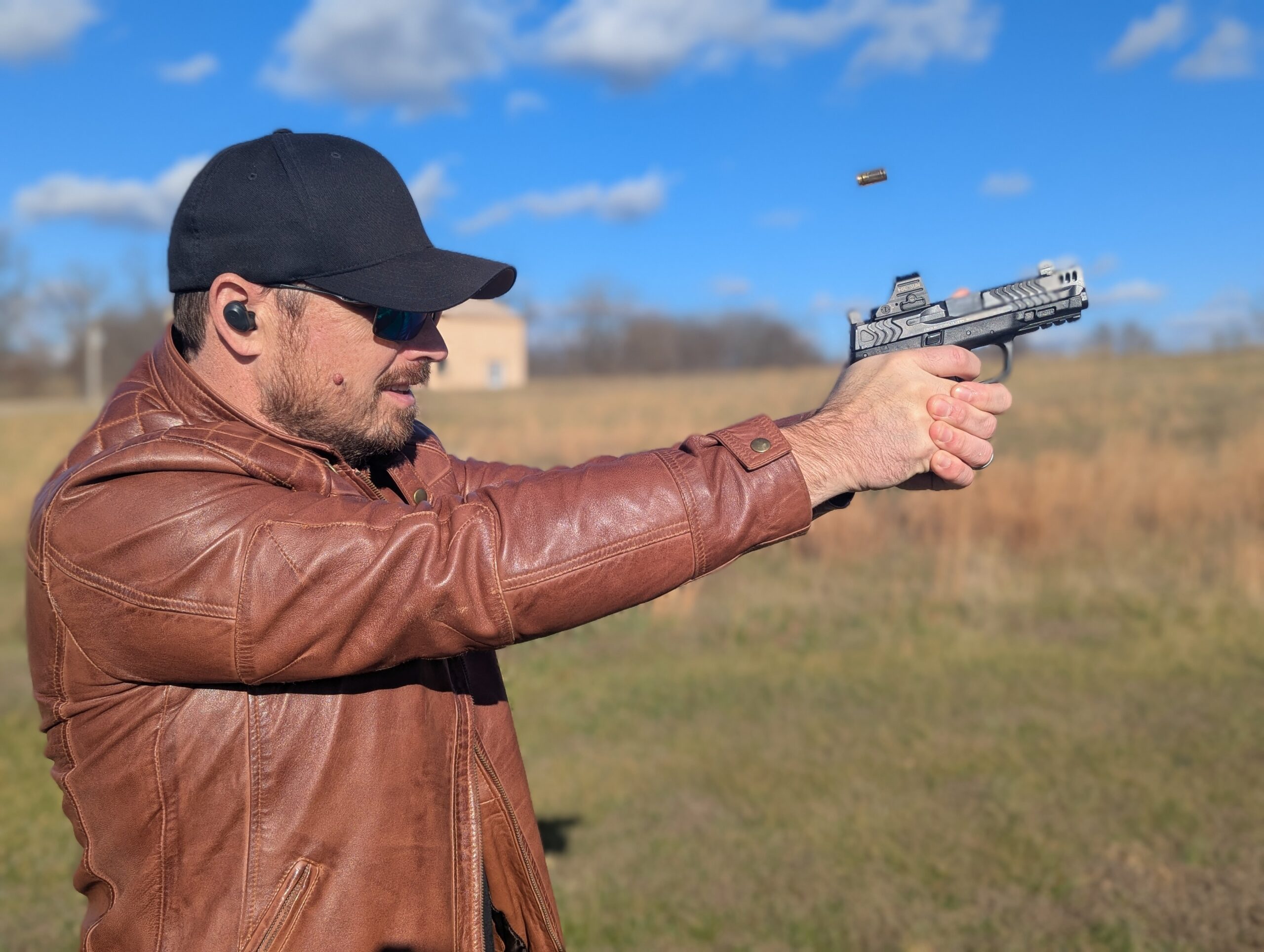
Drills are important tools for developing our skills as a shooter: they help build fundamentals, expose mistakes, and measure our current levels of competency. And, they’re just a lot of fun to shoot. Given the immense number of drills available, I thought I would do a series of posts discussing some of my favorite drills, either ones that I use now or ones that were helpful to me when I started defensive shooting and concealed carry.
Let’s look at a drill that addresses one of the most critical fundamentals of shooting: Trigger Control At Speed Drill.
Trigger Control At Speed Drill
At a distance of your choosing, aim in on a target of your choosing, index finger just touching the trigger. On the start signal, immediately fire one shot. Repeat as desired.
The Details
This is a simple drill that is intended to refine your trigger control. There’s no pass or fail, and no real standard that you’re shooting for; this drill is purely a tool to identify trigger control issues and help you correct them.
The drill is simple: aim in on your target with the sights exactly where you want them and your grip exactly how you want it. Put your index finger inside the trigger guard, either off the trigger or just touching the face of it. On the start signal (if you’re using a shot timer), immediately fire one shot. Your sights and grip should be exactly how you want them, so there should be no hesitation before pressing the trigger. In fact, the “fire immediately” element is one of the most important parts of the drill. The point is to use the same trigger speed in this drill as you use shooting quickly in any other drill or competition, only for this drill, you’re isolating the trigger press to find your mistakes. If you press the trigger at a deliberately “slow” pace to make sure you get the hit, you’re not revealing the mistakes you make when you’re shooting “quickly.” If you’re getting all hits, you’re not pushing yourself enough; you need to react quicker to the signal, or you need a smaller target. You learn from the “failures.”
The target and distance can be whatever is needed to push you to your limits. Using a target and distance that are easy for you to get your hits teaches you nothing. At the same time, using a distance so long that you can’t even get on paper won’t teach you much either. Pick a target and distance combo that will challenge you so your mistakes get revealed and you can start to diagnose the causes.
One of the great things about this drill is that it works equally well in dry fire as it does in live fire, maybe even better. Remember, this drill is about isolating the trigger press, and one of the best ways to isolate that skill is to remove everything around it, including recoil. If you try this drill and the sights move outside your target on the press with an empty gun, why would you expect things to be better with a loaded gun? Work this drill dry until you can reliably keep the sights in the target through the immediate press, and then “check your work” by shooting the drill live.
Variations
Other than target and distance, the other main variation on this drill is where you start your index finger. Above, I specified in the trigger guard, not touching or barely touching the trigger, but you could also start with the trigger prepped against “the wall,” or with your finger outside the trigger guard, indexed along the frame of the gun. Each position will teach you something different, and you should practice all three.
And what if you don’t have a shot timer? You don’t have to have one, but it does help to have a random start signal to keep you from getting into a rhythm or anticipating the trigger press. There are free apps for your phone that will give you a random beep, or if you have a partner, they can just give you a signal. And if all else fails, you can certainly do the drill by just being relaxed and then immediately breaking the shot. Timer or no, be honest with yourself about the “immediate” part.
Parting Shots
The three most important fundamentals of pistol shooting are grip, sights, and trigger. This drill isolates the trigger press so you can focus on finding your mistakes and cleaning them up. No matter your skill level, this drill will show you something you can work on to improve your marksmanship. If you’re struggling to get your hits but you’re not sure what’s wrong, reach out, and we can identify the issues and build a program to keep your development moving.

