
Drills are important tools for developing our skills as a shooter: they help build fundamentals, expose mistakes, and measure our current levels of competency. And, they’re just a lot of fun to shoot. Given the immense number of drills available, I thought I would do a series of posts discussing some of my favorite drills, either ones that I use now or ones that were helpful to me when I started defensive shooting and concealed carry.
Next up, the 5 Yard Roundup.
The 5 Yard Roundup
By: Justin Dyal
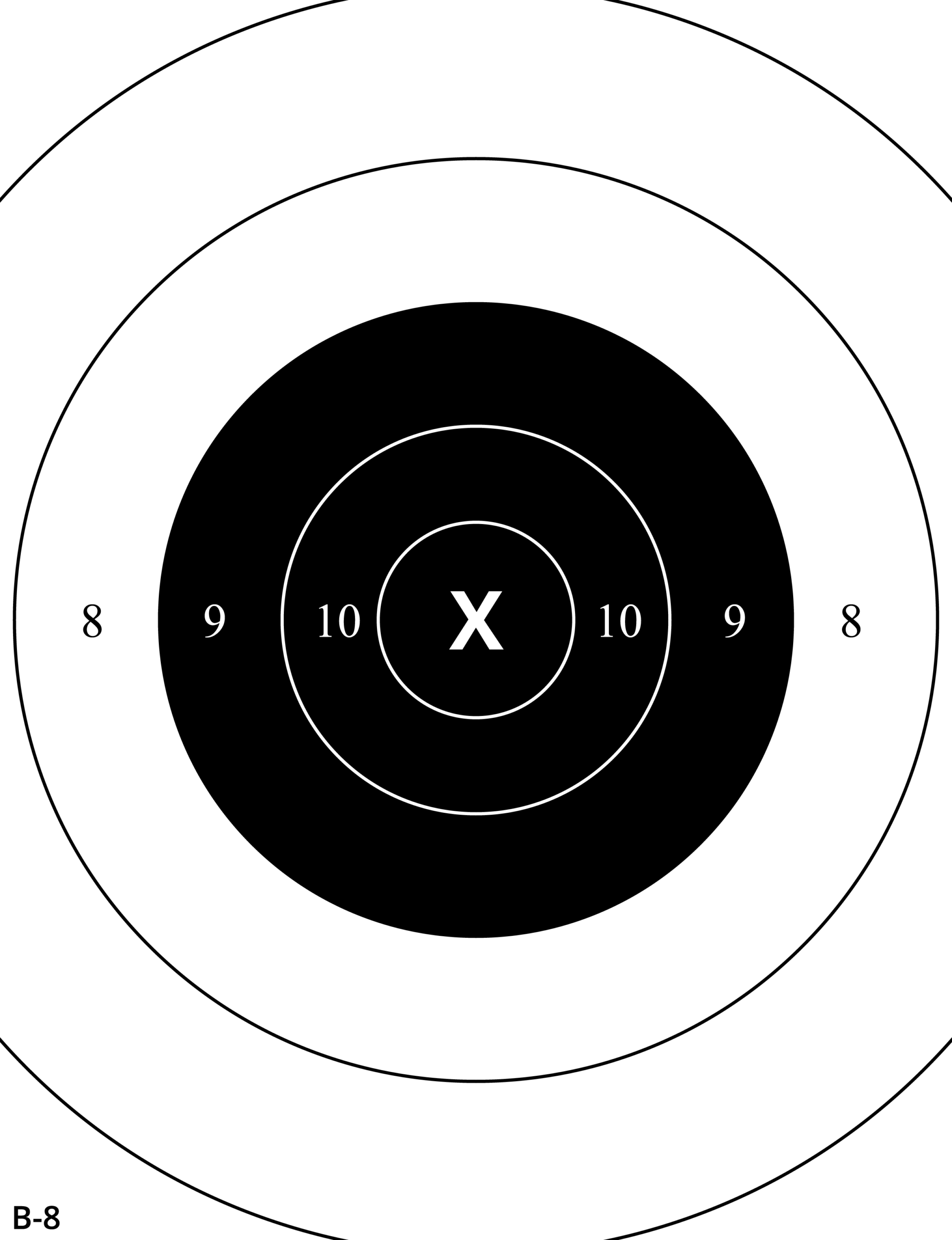
Target: B-8 Repair Center
Distance: 5 yards
Rounds needed: 10
All strings are shot from the 5-yard line, and all strings have a 2.5-second time limit.
String 1: From the holster, draw and fire 1 round.
String 2: From the low ready (aimed at the ground under the target), fire 4 rounds.
String 3: From the low ready, fire 3 rounds strong-hand-only.
String 4: From the low ready, fire 2 rounds support-hand-only.
Score by the rings of the B-8 target. Any shots off the paper are minus-10 points. Any shots over time are minus-5 points.
The Details
In a class I took with Wayne Dobbs, he called Justin Dyal the “Master of the 10 Round Drill.” I think this drill exemplifies that. 10 rounds, a simple distance, a seemingly “easy” par time, using one of the most common targets around, doing basic shooting tasks. But put it all together, and you have a drill that will challenge even very solid shooters.
The par time of 2.5 seconds will not be all that difficult for experienced shooters, but hitting Justin’s score standards in that amount of time will likely be a challenge, especially the last two strings. Most shooters don’t practice one-handed shooting, especially support-hand-only, much, if at all. I’ve seen a lot of shooters (myself included) handle the first two strings pretty easily, only to fall apart when it comes time to shoot one-handed.
The trick with the drill isn’t just getting the shots off in the 2.5-second window; it’s getting 9 or 10 points on each shot. Justin has multiple standards for different levels of shooters. The first step is simply getting all shots on paper within the time limit, which is solid work. The next level is a score of 90 or better. Justin says this is what he looks for from SWAT or instructor-level individuals. The final level is 95 or higher, which Justin says is fantastic work.
Variations
If you’re consistently getting 90s, then you may want to try the advanced version of this drill. The time limit drops from 2.5 seconds to 1.5 seconds. For this version, you’re not scoring by the rings, you’re just trying to get as many hits into the 8-ring or better as you can.
Justin also has a rifle version of the drill. It’s generally the same drill, but shot at 10 yards instead of 5. The first string is from an empty chamber (charge the rifle, then fire one round). The second string is the same as pistol, 4 rounds from the low ready. The third and fourth strings are also the same as the pistol: one-handed, shouldered against the strong or support shoulder.
Conclusion
The 5 Yard Roundup is a simple drill that can push any shooter to their limits. To really perform well on the drill, you need consistent hits to a relatively small target (the 10-ring). The drill will also show you just how lacking your one-handed shooting is; it won’t exactly be pleasant, but it will be revealing. Support-hand only shooting isn’t a skill that is commonly needed for civilian self-defense, but strong-hand only shooting is much more common than most people realize.
Give the 5 Yard Roundup the next time you’re out at the range and see how you do. I guarantee you’ll find at least one important skill to work on.
Train well-rounded.

