
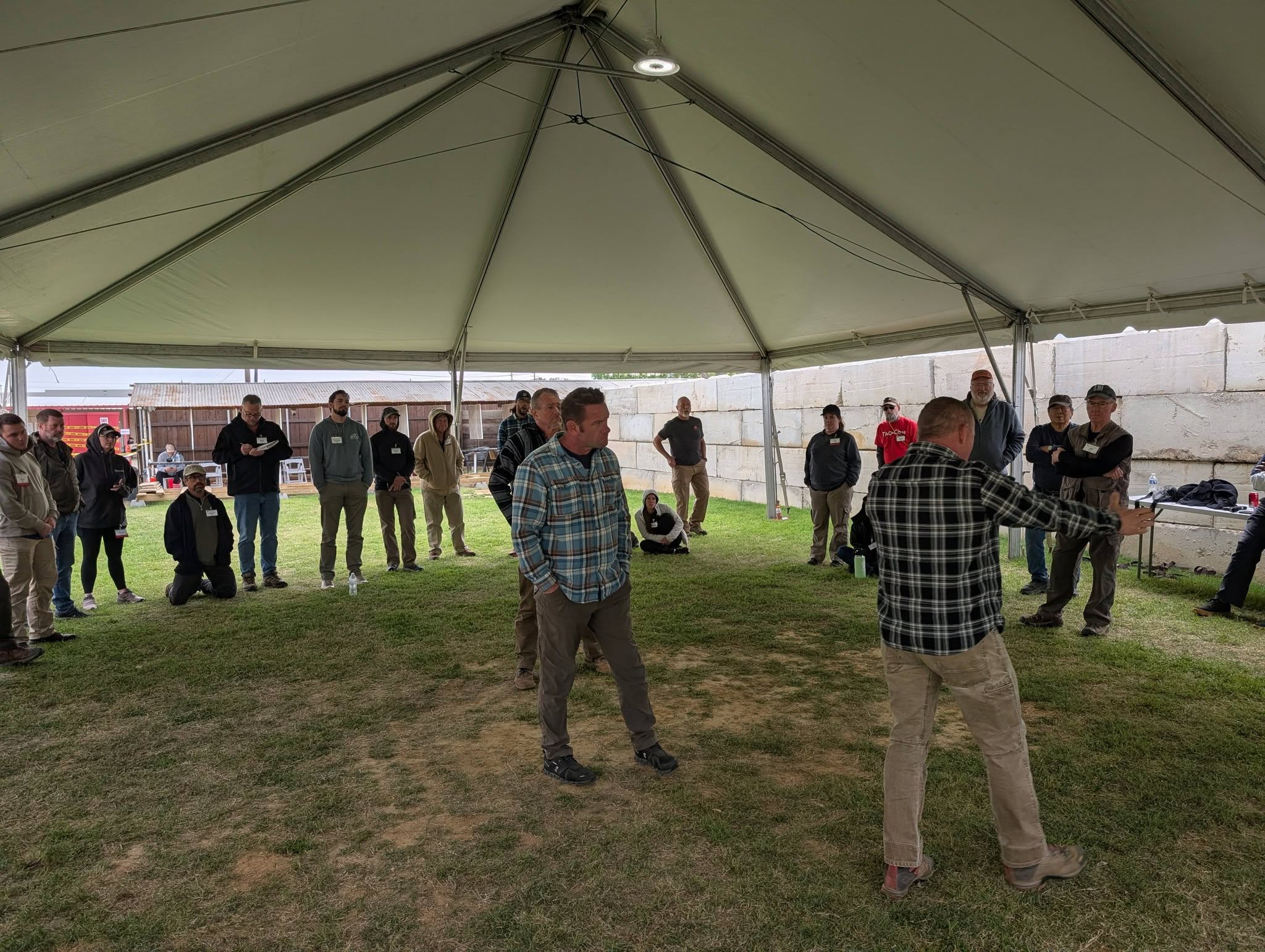
Getting Handsy
Some of my favorite training blocks across all my TacCons have been in the “hands-on bay.” It’s pretty much exactly what it sounds like: an area where instructors can teach hands-on techniques and skills. Over the years, I’ve taken numerous blocks in the bay, including counter-knife, grounded weapons fighting, executive protection, first-aid, and multiple classes on dealing with individuals with ambiguous, but potentially violent, intentions.
Keeping Hands-Off In The Hands-On Bay
Both Craig Douglas’s Managing Unknown Contacts and Chuck Haggard’s Close Quarters Street Skills were focused on dealing with strangers with potentially dangerous intentions, especially out in public spaces. Some dismiss the topic as a lot of noise about nothing, suggesting there’s nothing difficult or complex about it: “Just pay attention and don’t let them get close.” That’s easily said, but both classes highlighted that reality has far more nuance.
And as a quick aside, anytime I hear someone lead off their solution to a defensive scenario with some version of “I’d just…,” they’ve already pretty well established for me that they’ve given the topic no real thought. “I’d just shoot them.” “I’d just run away.” “I’d just yell for help.” People who think they can distil the vast variance and nuance of the real-world into such black and white simplicity are people who have never done any serious reality-based training, or even critical thinking, about defensive incidents. They’re not living in the real world; they’re the lone inhabitant in their fantasy world. In my opinion, the correct solution to a defensive scenario will almost always open with, “It depends on the context…”
Managing Unknown Contacts (MUC)
As I mentioned above, I would summarize MUC as managing interactions with strangers with ambiguous, but potentially dangerous, intent in a socially acceptable way that maintains our safety. One of the keywords there is “ambiguous.” When people discuss dealing with strangers approaching them, they often presuppose either violent or non-violent intent, and then discuss how they would handle the individual. However, the “knowledge” that the stranger in the scenario did or did not have violent intent is something they’ve magically given themselves as the author of the scenario. In reality, we usually can’t definitively say what someone’s intent is, at least early on in the interaction; we can only make reasoned inferences from their behavior.
Part of the MUC paradigm is understanding that the man approaching you quickly and directly could very well be a threat, or he may be coming to ask you to help him get a dying baby out of a hot car. MUC is about having reasonable actions that we can take to help us maintain distance while also assessing the person’s behavior.
Distance Is Priceless
Distance is critical, not just in MUC specifically, but in self-defense in general. The more distance we have between ourselves and another person, the more time we have to react to their behavior and actions. So how do we maintain distance and keep strangers out of potential striking distance, while maintaining social credit? Much of the MUC curriculum is focused on building and maintaining boundaries between us and others through verbal and physical means.
The first boundary is a verbal one. We use our words to communicate that we want the person to keep some distance between us. Craig and Chuck both encouraged the “ask, tell, make” process. Verbally, the process would be a polite request that the person hold up where they are. If they continue to advance, you firmly tell them to stop, and if they still continue to close the distance, you forcefully give a command to stay back.
The physical boundary reinforces the verbal, while also putting us in a position very close to a fighting stance, without being aggressive or over-the-top. The fence, or the interview stance, is simply having your hips square to the person, with your hands up near your chest. It serves two purposes: first, it gets your hands and arms up in a strong position to defend yourself; second, it’s the body-language version of “please stay back,” with the benefit that practically every culture understands it, regardless of the language spoken. From the fence, if things go sideways and we wind up moving to the “make” stage, we’re in a good position to take action.
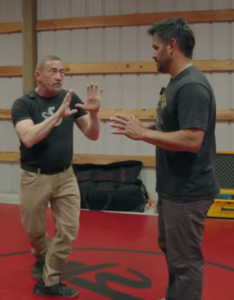
An important note that both Craig and Chuck stressed, along with Cecil Burch in his Contact Distance Shooting block, is the importance of arcing rather than backpedaling to create distance. There are two reasons for this: first, the human body is not designed to effectively move straight backwards. Even the best athletes in the world can only backpedal a short distance before they swivel their hips and turn to run forward. Second, as both Craig and Chuck discussed, if this approaching stranger does have malicious intent, there is quite possibly at least one more assailant, and they are likely behind you. Arcing away from the first stranger brings what was previously behind you into your peripheral view, so you can gain awareness of your entire surroundings.
What If They Do Have Violent Intent?
Both instructors highlighted the realities of violent criminal behavior and the “framework” commonly seen in assaults:
- Unequal initiative – the bad guy chooses when the fight starts, and depending on how much attention we’ve been paying, we may not have any heads up.
- Unequal weaponry – many assailants will be armed either with a dedicated weapon (e.g., knife, gun) or an improvised weapon (e.g., hammer, syringe).
- Extreme close quarters – assailants almost always close the distance to either get what they want or to use force.
- Multiple assailants – there is safety in numbers, and that goes for violent criminal actors as much as it does for us; they often work in packs.
Going back to the question of initiative and how much attention we’ve paid, both training blocks also ran students through the most common pre-assault indicators, and drills on how to stay observant when dealing with aggressive contacts. The most common pre-assault indicators are:
- Grooming – rubbing the neck, face, hair, or arms
- Witness checks/target glancing – checking over their shoulder, staring at your chin or your phone
- Distinct weight shifts – shifting weight to load up for a strike, and
- Picking – constantly picking or touching around the waist or pockets, where their weapon is.
While Craig’s block was focused entirely on the interaction with unknown contacts before they get too close, Chuck spent some amount of time discussing the importance of seeing potential trouble before it’s even close enough to interact with, and also covered what to do if the stranger moves “through” the MUC process into an actual attack.
Wrap Up
Most of this sounds simple and a lot like common sense. And it is. But because something is simple doesn’t mean it’s easy, or that it doesn’t take practice. As a prime example, during one of the classes, we did a simple drill with a partner where one person was the unknown contact and the other was the “defender.” The partner playing the contact would approach the defender and interact with them while randomly cycling through the pre-assault indicators mentioned above. The defender’s job was to maintain distance, interact verbally, keep their fence up, and say “cue” anytime they noticed the contact show a pre-assault cue. That all sounds simple: “Just pay attention and don’t let them get close,” right? The reality is, I lost count of the number of cues I missed when I got sucked into the verbal dialog with my partner, or the number of times I let my partner close the distance because I was too focused on cues. And it wasn’t just a problem for me; everyone struggled. It’s a surprising amount of mental load to manage distance, interact verbally without being sucked into a conversation, keep your body positioned properly, move correctly, and observe the contact’s behavior and your surroundings.
The training blocks highlighted yet again the differences between fantasy-based training and reality-based training. One is artificially constructed to play to our strengths and comfort, the other is built to reveal our deficiencies and make us better.
Train for reality.

