Poking Holes In People
Two of my training blocks at TacCon 2026 were on techniques and concepts for extreme close-quarters and entangled fights. One was Greg Ellifritz’s block on using edged weapons when hands-on with an assailant, and the other was Cecil Burch’s block on using a pistol in an entangled assault (a.k.a. retention shooting).
To start, these kinds of fights tend to be uncommon for ordinary concealed-carry (CCW) defenders (law enforcement officers are a very different context). That’s not to say that entangled fights are uncommon; they certainly aren’t, but the use of edged weapons and firearms in extremely close quarters by CCW defenders isn’t the norm. Having said that, while it may not be “common,” it’s absolutely not unheard of by any means. The vast majority of my entangled-fight training is unarmed (Jiu Jitsu and striking), which I believe will be my most likely needed skills in a hands-on fight. However, given that I already carry a pistol and a knife, and given that the odds of needing to use them at extremely close distances are not zero, I want to at least be competent with those tools in extreme cases. With pistols specifically, I will routinely shoot out to 50 yards, sometimes even 100 yards, not because I think the use-case is likely, but because it’s not zero, and I’ve already got the tool on me. I have the same idea about using the pistol at 0 yards as I do at 50.
It Won’t Be Pretty
I should also address the fact that, specifically when discussing the use of knives and edged weapons for defense, juries seem to take a dimmer view of a CCW defender using a knife versus using a firearm to defend themselves. As bad as a gunshot wound can be, knife wounds are often more gruesome. A fatal gunshot wound may leave an unimpressive-looking mark on the body, while a non-fatal knife wound can often be gory, with torn flesh and muscle and significant amounts of blood. The perceived severity of the wound can have a significant impact on how a jury views the reasonableness of a defender’s actions.
On top of that, in American culture at least, knives and edged weapons tend to be viewed as the weapon of choice more for criminals and thugs than ordinary citizens. It might be one thing to a jury for you to grab a knife from the kitchen as a spontaneous weapon of self-defense, but another thing entirely to use a knife that you always carry on you. The jury may wonder what kind of person carries a knife specifically to be used on another person, assailant or not. I’m not saying I agree with this potential assessment; I’m simply acknowledging the reality of it and how it impacts innocent CCW defenders. None of this is to say you shouldn’t carry a knife for self-defense, just things you should consider when making your own decisions.
To this point, Greg Ellifritz pointed out that it would be better to land two effective stabs/slashes on an assailant rather than having to land 22 minor cuts to get them to stop their attack. A jury or a prosecutor may very well view those two scenarios very differently, looking far less favorably on the assailant with 22 slashes. Greg also briefly discussed giving thought to other people’s perceptions of the individual knife you use as well, pointing out that a hyper-tactical knife, or a foot-long blade, can absolutely be viewed by others as something a ne’er-do-well would carry, rather than an “ordinary,” reasonable person. Again, I’m not saying I agree with those assessments, simply that they exist.
Self-Defense With Edged-Weapons
Greg’s training block was focused on practical and simple techniques for using a knife for self-defense, specifically on the main areas of the body where a slash or stab would be likely to stop an attack quickly. Greg’s focus on the basics of both the techniques and locations was appreciated; while someone with more edged-weapon skills might have found the training block too elementary, as someone looking for competency rather than expertise, the basics were exactly what I needed.
Greg went into basic, but specific, ways to hold the knife and the advantages and disadvantages of each method, multiple techniques for stabbing and slashing, and locations on the body to apply the techniques to produce the needed effects to stop the assault. We went through different scenarios that an innocent defender might find themselves in, such as being held from behind or the front, choked from different positions, and defending strikes or knife attacks.
On the different locations to which we can apply the edged weapon, Greg broke them into two general categories: locations that will disable, and those that will incapacitate. Disabling locations, such as tendons or major muscle groups, aren’t likely to cause unconsciousness or death, but if done correctly, can cause the failure of the limb, possibly immediately. On the other hand, incapacitating locations (major blood vessels) are those that will likely cause blood pressure to drop enough to render the assailant unconscious. The potential issue with incapacitating locations is that, depending on the severity of the wound, it might take several seconds before the assailant is actually incapacitated. While a few seconds doesn’t sound like much, it’s an eternity if someone is trying to put a knife in your throat. When we need to stop an assault, we need to stop it now. To that end, Greg suggested a strike to a disabling location followed immediately by a strike to an incapacitating location if needed.
Contact-Distance Retention Shooting
Staying at the entangled-fight distance, Cecil Burch taught the techniques for retention shooting when entangled with an assailant. Cecil stressed a couple of concepts for retention shooting: we remain accountable for every round fired (and it is absolutely possible to miss at close distance), and we must retain the weapon (hence the name “retention shooting”). To the first concept, Cecil and the rest of the Shivworks group teach a thumb-pectoral index position for the weapon hand rather than a magazine-waist index position.
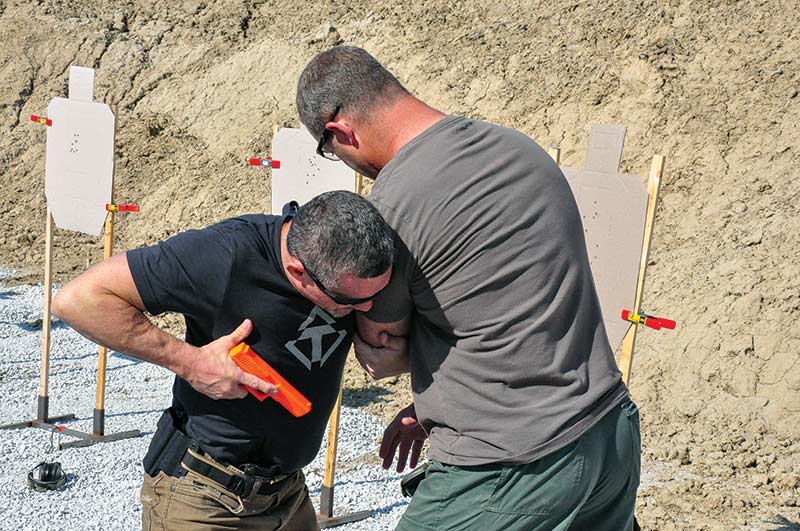
Thumb-pectoral index. Note the angle of the muzzle in relation to the shooter’s grappling hand. Where would a miss go from this position?
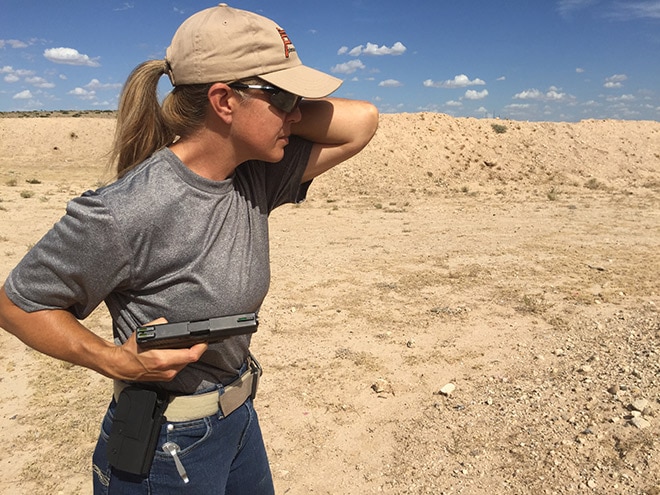
Mag-waist index. Where would a miss go from this position?
The former, with a high elbow, will naturally orient the muzzle down toward the hips of an assailant, while the latter points the muzzle parallel to the ground. While the parallel muzzle sounds preferred for putting shots into an assailant, it often results in one of two outcomes: shots in the abdomen of the attacker, or shots off target and into the world. The first is frequently ineffective, and the other is simply unacceptable.
With the thumb-pectoral index and downward-pointing muzzle, shots will either strike an attacker’s hips and legs or will impact the ground immediately under them. The first may still be ineffective, but the latter is not immoral. That’s a clear win for thumb-pectoral. The downward angle of the muzzle from the thumb-pectoral index also decreases the chance that we shoot our own hand or arm, which is likely entangled with the assailant. Cecil also pointed out that, with any retention shooting position, the goal is to first diminish the assailant, so that we can then gain dominance or distance and disable them from there.
In an entangled fight with an assailant, any tools we use, including a pistol, can quickly go from “my pistol” to “our pistol.” If the assailant is close enough to grab us, they’re close enough to grab the pistol. Therefore, we have to assume a position that lets us make sure the pistol is always “mine.” Both common retention shooting positions do a good job of putting us into a position to retain control of the pistol, but having experienced both, I believe the thumb-pectoral position, with the high elbow, puts us in a stronger position.
Cecil made two observations about using pistols at close distances: first, when thinking of whether or not the threat is too close to present the pistol to full extension, he said the question we should really be asking is, “How far away is too close?” I found that to be a very good way of expressing the concept that people can quickly close a significant distance and be hands-on with us (ref: the Tueller principle). By phrasing the concept this way, it reinforces the idea that people can grab us or our tools from unsettling distances.
The other observation Cecil made was that retention shooting isn’t really a shooting situation at all; it’s much more a fighting situation. It’s a difference in both technique and mindset. The fundamentals and concepts of shooting take a backseat at this distance to the priority of simply keeping the weapon and diminishing the assailant. At this distance, we use the pistol (or knife) to fight our way to distance or dominance, then we can focus on definitively stopping the attack.
Train for the up-close and personal.

