Learning and Teaching
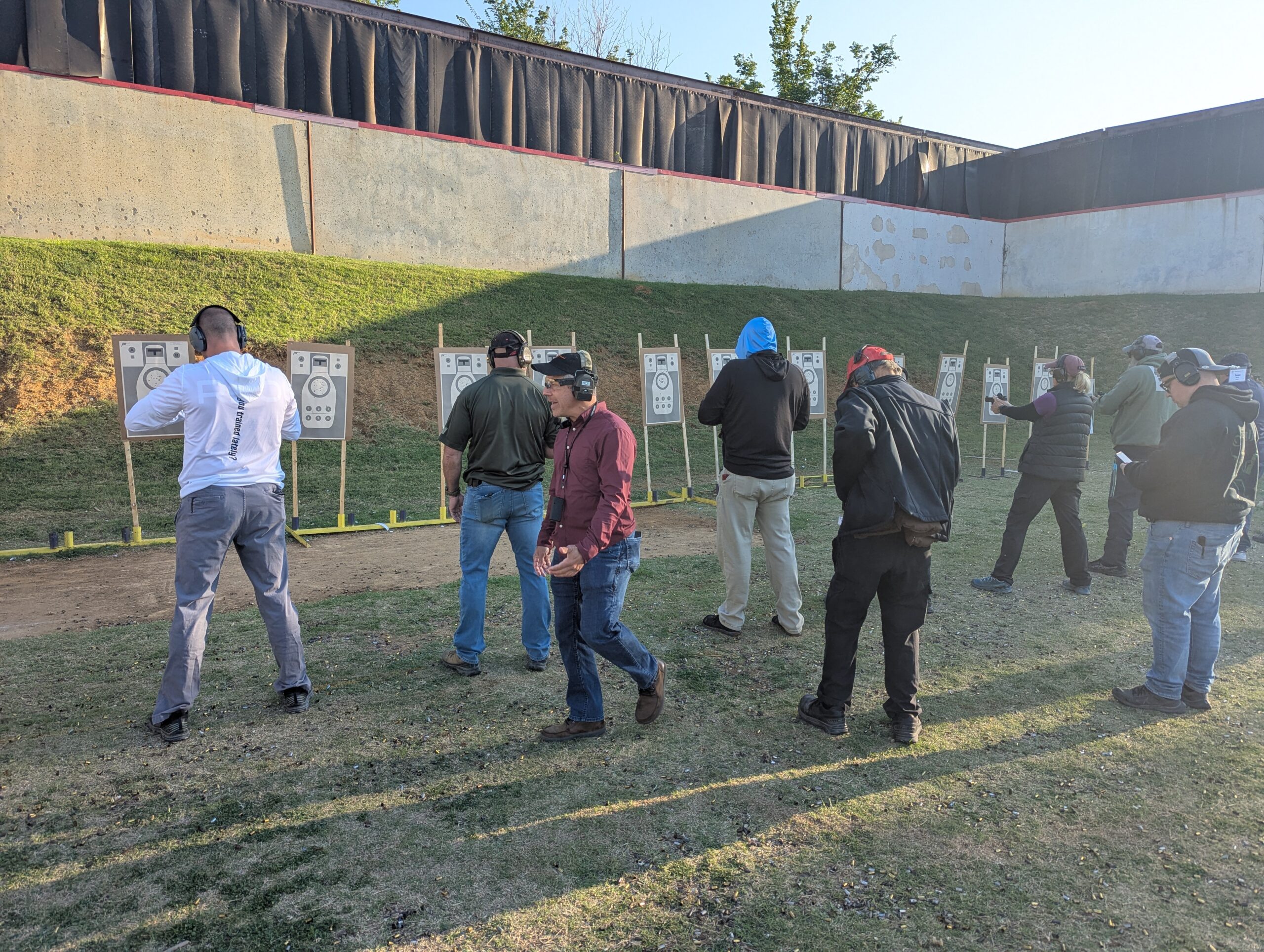
One of the best aspects about TacCon for me is that it provides me with the opportunity to view classes from both the student and instructor’s perspective. In every block, I’m a student, but I also get to watch highly experienced instructors teach classes. And some blocks are specifically geared to teaching us students how to teach.
Cold Performance
One of the blocks I attended, taught by fellow Missourian Simon Golob, was Cold Performance. The class was focused on what is arguably the most important, valuable, and revealing training time that we have on a range: our first few shots cold (no warm-up or “getting loose”).
As civilian defenders, we don’t get much, if any, say in when and where we will be assaulted, and there are no time-outs so we can get warmed up and make sure all our gear is right where we want it. If we have to defend ourselves or our loved ones, we do so with whatever we have at the moment, in whatever condition it is in, with the lowest level of skills we have developed. The cliche that we “rise to the occasion” is a blatant and obvious lie. We do not rise to the occasion; we sink to the lowest level of skill we have developed. On the day someone is trying to murder your child, you won’t turn in a record-breaking performance; you’ll turn in the worst performance you’ve had in six months. We train not to raise our skill ceiling, but our skill floor.
For over a year, I’ve been tracking my cold performance both in dry fire and live fire. In dry fire, before doing anything else, I time my draw-to-first-shot. It is never the “best” that I can do. But it is indicative of what I’m likely to do should I need to draw a firearm to defend myself. During live fire, I start each session by shooting the Bill Drill (6 shots to an 8″ circle from 7 yards from concealment). Again, the result is never my “best” run, but it is far closer to the reality of my performance in a self-defense incident.
These cold reps are invaluable because after even the very first run, we’re starting to warm up and acclimate to the task at hand. We only get a handful, or maybe even just one, run while cold. These reps are a great indicator of our skill improvement and development. If you’re doing a lot of practice but seeing no improvement in your cold performance, you probably need to reexamine your training and practice.
Real Confidence Requires Receipts
The training block with Scott Cronin of Gunset Training Group was similar in theme to the Cold Performance block (skills that win fights), though with a different emphasis. Scott’s emphasis was on the fact that delivering under stress requires confidence, and confidence comes from validating our skills against measurable benchmarks. We shot the first two strings of the Gunset pistol standards, which are set not for the high-speed, low-drag performance shooter, but the armed citizen who just wants to get home to their kids. The point of the standards, and really all our training in general, is to honestly measure our performance, identify our skill deficiencies, and then develop a plan to address them. Easily said, but our egos frequently get in the way.
Most people don’t enjoy doing things they’re not good at. We tend to practice the things we’re already comfortable with and skilled at, because we’re comfortable with it and skilled at it. It’s a nice boost to the ego. On the other hand, working on a skill we suspect, or already know, we’re not good at, is a humbling experience. Yet, that’s where growth and development occur. It’s like avoiding the gym because you know you’re out of shape, and it’s going to be humbling work to get better. Yeah, you avoid the sore muscles and sore ego, but you also avoid the growth and development.
Scott’s block was as much about teaching our own students the value of benchmarking their skills as it was about us benchmarking our own skills. The Gunset standards are not that difficult for an experienced shooter to at least pass (though performing to the “Patch” level is more difficult), but for a new shooter, they can be quite challenging. The point is to set reality-based standards so that students can judge their skill level and make informed decisions about what skills they want to work on.
Undertrained Concealed Carry Tactics
Gabe White’s training block on Undertrained Concealed Carry Tactics was another class oriented towards giving us ideas on how to teach our students important tactics for concealed carriers. Having trained with Gabe previously, I know he believes in the importance of both technical skills and tactical knowledge for self-defense. Being an incredible shooter is all well and good, but if your response to someone shooting at you is to stand rooted in place, your technical skills won’t be much help while you’re lying on the ground bleeding out. Our skills should complement our tactics, and our tactics should complement our skills.
On the topic of undertrained tactics, Gabe discussed the scenario of dealing with an assailant in a crowd, say a church sanctuary or a parade. If we have to deliver shots on a target with a background full of innocent people, we have absolutely no margin for error. So how can we influence the situation and increase our margin for error? Move. Taking two or three steps to the side may very well clean our background up completely, giving us the opportunity to engage the threat more rapidly and confidently. Gabe also had us change the angle on the target (and the background) by first dropping to one knee. Depending on the distances involved, changing the vertical angle of the shot could be an even better way to clean up the background. These are simple tactics; there’s nothing flashy or Instagram-worthy about them, but they are highly effective and can be taught to anyone taking a defensive firearms class.
Gabe also ran us through a drill intended to introduce students to the self-defense legal concepts of imminence and proportionality. As civilian defenders, we can only use force to defend against an imminent attack, and can only use a level of force equal to the attack. Gabe’s drill is simple (tailored for the inexperienced student), but effective at introducing concepts to students that they likely hadn’t given much thought to in a grounded, real-world manner. I’ve already started incorporating the drill into my concealed carry and self-defense classes, and students have highlighted the drill as one of the most effective parts of the class. I’ll do a separate blog post on the drill soon, so stay tuned.
Parting Shots
This year’s TacCon was a great opportunity to develop my skills and knowledge as a shooter, defender, and teacher. I highly recommend it to anyone who is serious about self-defense, no matter your skill level. I’ve already signed up for next year’s TacCon, and I hope to see you there.
Train hard.

