
Continuing our discussion of some of my favorite drills, let’s discuss the FBI’s Handgun Qualification. First, I’m well aware that this qualification, and most others, are not drills. But, like drills, the FBI qual is a course of fire (albeit a long one) that you can use at the range to learn about your current skill level and what you need to work on. Unlike most law enforcement quals, all draws in the FBI’s are done from concealment. If you’re looking to compare your skill to a “national standard,” this is a good place to start.
In fact, when I first started shooting, passing the (previous) FBI qual was one of the first mountains that I set out to climb. The goal of passing the FBI’s qual helped push me to practice and improve. The qual is not much of a challenge for me anymore, but when I first started, it was difficult enough to push me without being oppressive. So, what is the FBI’s qual?
FBI Handgun Qualification (2019)
Total Rounds: 50
Target: FBI QIT
40/50 rounds anywhere in the silhouette to pass (45/50 for instructors).
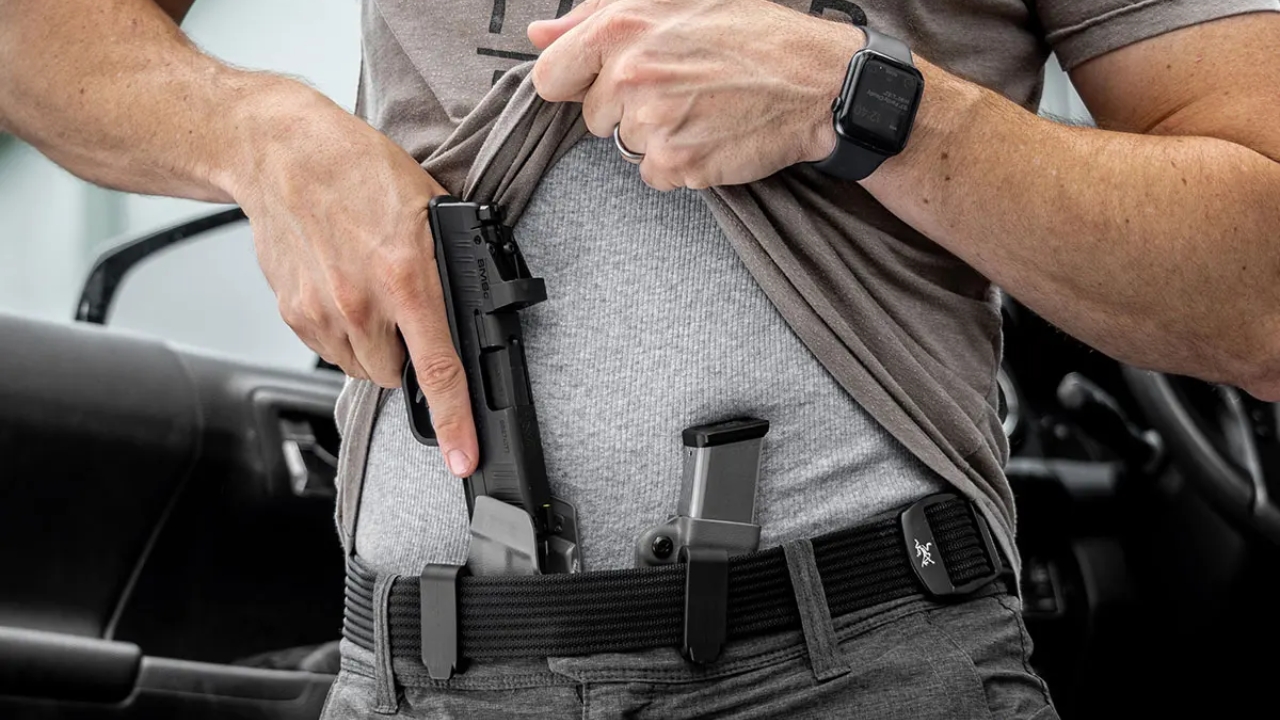
All draws are from concealment.
Only the first string is shot one-handed; all others are shot freestyle (two-handed).
3 yds
Draw and fire 3 rounds strong hand only, switch hands, fire 3 rounds support hand only, in 6 seconds.
5 yds
Draw and fire 3 rounds in 3 seconds.
From the low ready, fire 3 rounds in 2 seconds.
From the low ready, fire 6 rounds in 4 seconds.
7 yds
Draw and fire 5 rounds in 5 seconds.
From low ready, fire 4 rounds, reload, fire 4 rounds, in 8 seconds.
From low ready, fire 5 rounds in 4 seconds.
15 yds
Draw and fire 3 rounds in 6 seconds.
From low ready, fire 3 rounds in 5 seconds.
25 yds
Draw and fire 4 rounds standing, drop to a knee, fire 4 rounds kneeling, in 20 seconds.
My Thoughts
First, when switching hands on the first string, make sure you’re doing so safely! The FBI Q target is very generous, and at only 3 yds, the shooting is not the hardest part of this string; it’s a safe transition.
A blazing-fast draw isn’t needed for any of the strings, but you obviously can’t have a 3-second draw and expect to draw and fire 3 rounds in 3 seconds or less. When I first started shooting, I didn’t train reloads, so the string of fire from 7 yds that requires a reload was problematic for me. Basically, I just conceded 4 misses right there (assuming I wouldn’t finish the reload in time to fire any after), and if I was able to get a shot or two off after the reload, then that was a bonus.
As I said, the target is quite generous in size, so hitting at the “longer” distances of 15 and 25 yards isn’t a huge marksmanship challenge, but if you’re new to shooting or performing under time constraints, you may struggle a bit. The 20-second time limit for the final string is an eternity; you’ve got plenty of time to make sure your trigger presses are appropriately deliberate. The move to kneeling doesn’t really change much, but most people never practice it, so it feels weird and throws them off, or they try to make it something far more complex than it is.
Parting Shots
If you’ve been training for a bit and are looking for a challenge, give the FBI qual a run. You may pass it quite easily, or it might reveal some weak links in your skills. I don’t recommend shooting it over and over like a drill; your 50 rounds can be better spent on focused drills, but shooting it occasionally (preferably cold) until you’re able to pass it reliably can be a fun way of gauging your progress, and it gives you a “national standard” as a goal to work towards.
What’s always interesting to me when shooting law enforcement qualifications is the low bar that they set for agents or officers to pass. When I passed the old (but very similar) FBI qual for the first time, with a train-wreck of a reload, my first thought was, “That’s it? That’s good enough?!” But that’s a topic for another post. Give the FBI qual a shot and see how you do.
Train safe.

