
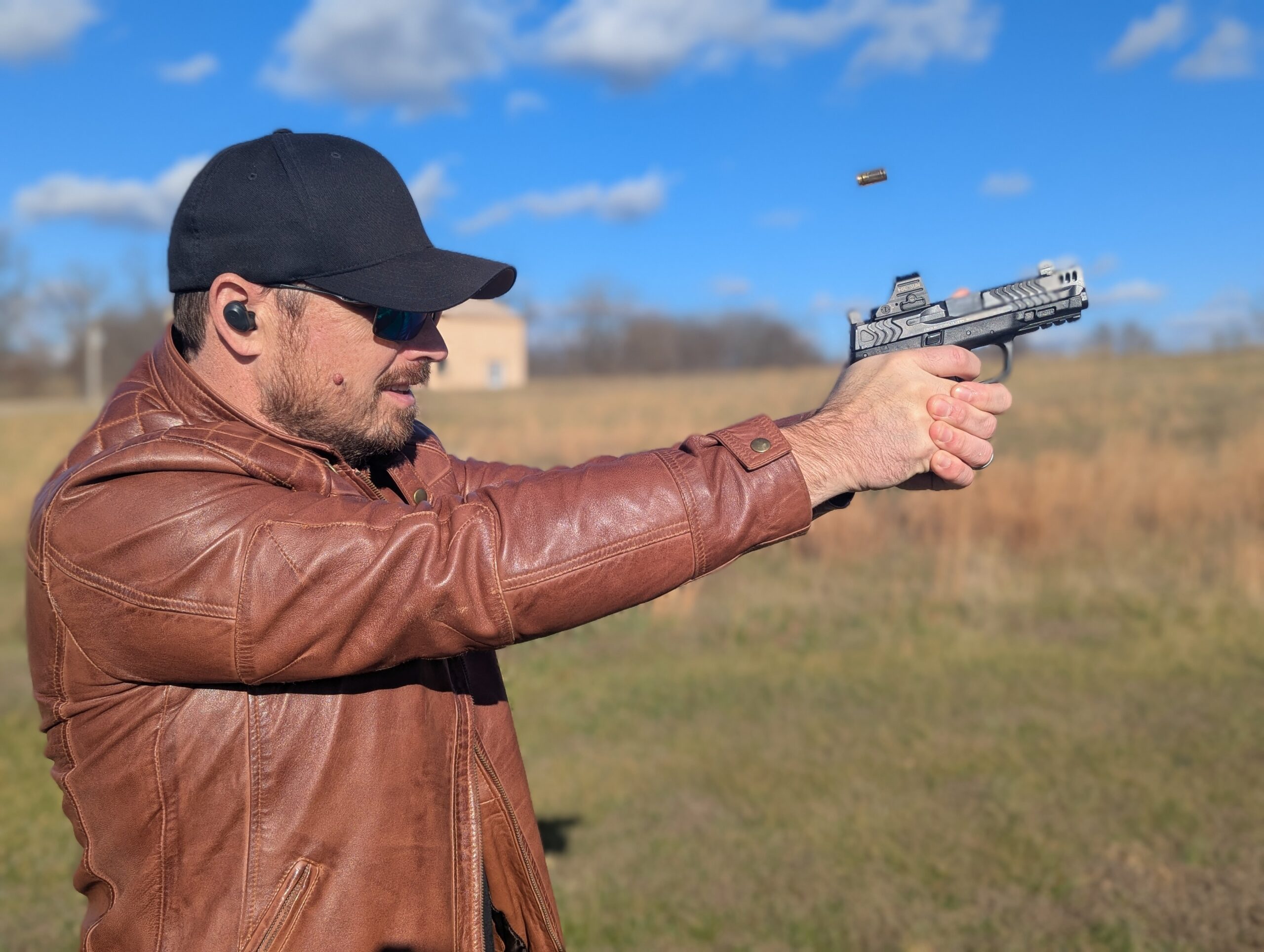
Drills are important tools for developing our skills as a shooter: they help build fundamentals, expose mistakes, and measure our current levels of competency. And, they’re just a lot of fun to shoot. Given the immense number of drills available, I thought I would do a series of posts discussing some of my favorite drills, either ones that I use now or ones that were helpful to me when I started defensive shooting and concealed carry.
Let’s look at a drill that addresses one of the most common mistakes that shooters (including myself) make, especially when shooting rapidly.
One Shot Return Drill
At a distance of your choosing, aim in on a small point and fire one shot, paying attention to how the sights return to the target. Repeat as desired.
The Details
As with most of my favorite or most-used drills, this one is very simple to execute, but requires you to pay close attention to what the pistol and the sights do as you shoot. For a lot of people, when they are shooting, they are either focused on where the holes are (or are not) appearing, or on nothing at all. When I ask students what they saw as they were shooting, I usually either get a blank stare, or something along the lines of, “…I don’t know.”
The issue with not paying attention to the pistol and the sights is that you miss out on incredibly important information that is only available momentarily. The results on the target are permanent; you can check them any time you want, but the movement and feedback of the gun and sights are fleeting: once you’re done shooting, the opportunity for observing them is gone.
This drill is focused on what the pistol and the sights do as they return to the target from recoil. Ideally, the sights (or dot) lift from the target with the shot and then quickly snap back directly to the target. The sights should never come back by dipping below the target and then coming back up, nor should they snap back close to the target and then slowly settle the rest of the way to the target. The sights should leave the target and then immediately return to the target. Any dipping or slowing of the sights is caused by the shooter applying input to the gun, either “over-driving” the gun back down and forcing it low, or slowing the return of the gun trying to be more precise.
Rather than using your muscles and trying to force the gun to return to the target, use your eyes to drive the pistol. Your body will naturally return the sights to your eye line if you just relax, laser focus visually on a tiny spot on the target, and let your hand-eye coordination do its thing.
When shooting this drill (and most any other drill for that matter), don’t worry about how much the pistol recoils. Instead, be aware of how the sights come back to the target. They should come immediately back, and they should do so the same way each time. As long as the sights consistently return directly to the target, you’re doing things right. You can work on the speed of the return as you go, but the most important thing is that the sights behave consistently and correctly.
You shouldn’t have to steer the sights or apply input to get them back on target. If the sights return anywhere other than the tiny point you’re focused on, then there’s probably an issue with your grip, or you’re not really visually focused. You can’t aim at the piece of paper, nor circle on the paper, nor the center of the circle; you need to aim for a piece of fiber in the center of the circle. For this drill, at least to start, your target should be a 1/2 inch dot on the paper.
Variations
There aren’t a lot of variations for this drill. Distance isn’t all that critical, because we’re not so much worried about the accuracy of the shot as we are the behavior of the sights afterward. Similarly, the target isn’t all that important either, though the drill will be easier with a small, high-contrast aiming reference vs. shooting a USPSA target with no markings.
Parting Shots
If you find your follow-up shots aren’t going where you want them to, or your time between shots is longer than you’d like, this is a good drill to use to assess what you’re doing to influence the speed and movement of the pistol as it returns to the target out of recoil. This is yet another drill that you can use no matter what your skill level is. The goal of this drill isn’t a time or accuracy standard; it’s perfection. Perfect return of the sights back to target. As long as you’re not perfect yet, you’ll find value in this drill.
Train consistently.

