
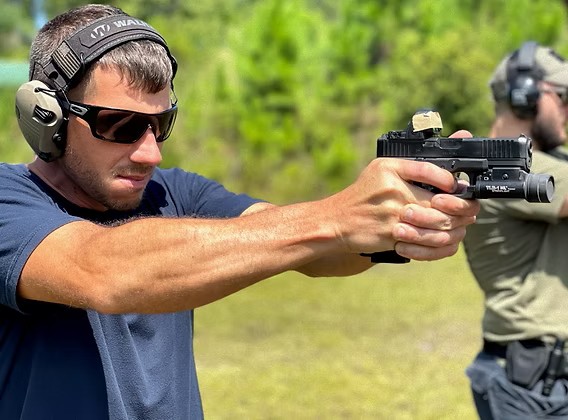
A friend of mine went to TAC CON with me this year and noticed that something was up with my pistol-mounted optic: there was a piece of masking tape across the objective (target) side of the glass. Upon seeing this, he had a simple question: “Why would you do that?”
Why Occlude the Optic?
To answer that question, we have to acknowledge a problem that can creep in while shooting with a pistol-mounted optic (PMO): becoming focused on the dot, rather than the target. PMOs are designed to allow you to shoot with both eyes open, focused on the target, while the red (or green, or gold) dot floats in the glass between your eye and the target. But the dot is a potentially vibrant point of light hanging out right in our line of sight, so our eyes naturally want to shift from the target to that jiggling ball of light. Shooting with the brightness of the dot turned down can help, but I run my dot bright enough to work in full sun at all times, which means that indoors it can be quite bright. So the problem is that our eyes will sometimes (or always, for some people) shift from target-focus to dot-focus, often without us even realizing it unless we’re paying close attention. So how do we fix that?
Occlude the Optic.
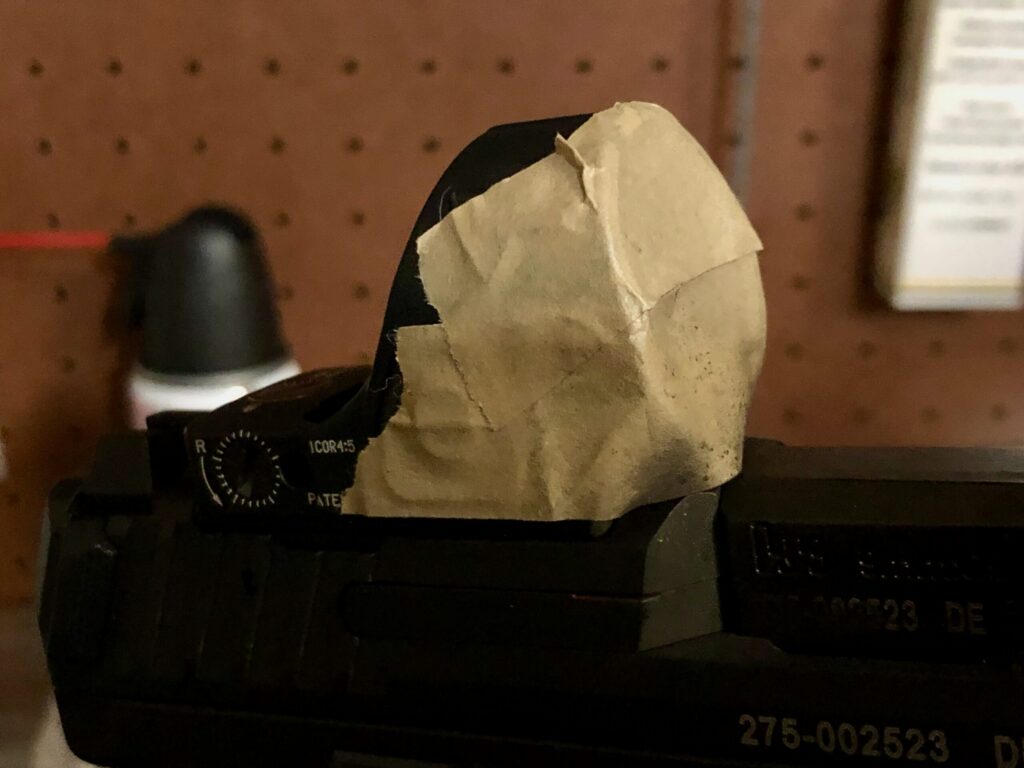
By covering the objective side of the optic, we create a situation that will instantly tell us if we focus on the dot rather than the target. When the optic is occluded, our dominant eye will see the dot, and the other eye will see the target. If we focus on the target, our brain merges the two images together and we see an unfocused dot floating in front of a clear target. But if we focus on the dot, we see a clear dot with an unfocused background, meaning we effectively lose sight of the target. This is a common occurrence for people new to PMOs, but it happens to most everyone at least occasionally. By occluding the optic, we’ll know pretty quickly if we shift focus to the dot, because the target will “disappear.” That is our signal that we messed up, and we need to make sure we’re visually focusing on the target, rather than the dot.
At this point, I don’t typically struggle with focusing on the dot, so I train with an occluded dot every couple of months, just to verify that I’m doing things right and to catch any bad habits before they get too ingrained. If you struggle with shifting visual focus, though, I would suggest occluding the dot most every time you train, both live and dry fire, until you work through the issue, then dial it back to more of a maintenance frequency.
Parting Shots
Usually when I explain occluded shooting to people, they stare at me with a blank expression and then say, “I still don’t get it.” I suspect that means I’m bad at explaining it, which means you may be thinking the same thing. So, if you have a PMO, I’ll tell you what I tell them: “Just try it.” As soon as you experience it, you’ll immediately get it. It’s a great way to make sure your visual focus is where it should be so you can shoot to the best of your abilities. It’s also handy for building confidence in your ability to use a PMO in adverse conditions. You’ll learn that, since you can shoot the pistol with an occluded optic, no amount of objective-side dirt, mud, grease, blood, etc. will impede your ability to shoot accurately. Even if the glass becomes cracked and completely spiderwebbed, as long as you can see the dot, you can shoot accurately.
Give occluded-optics training a try, at least occasionally, to build trust not only in your skills, but also in your gear.
Train with focus.

