Stand And Deliver
I don’t shoot formal competitions all that often; there’s not an organized competitive scene close enough for me to fit it into my schedule frequently. I do enjoy it, though, and I do compete as often as I can, even if it’s informally among friends or at classes. It’s a great way to push oneself and get acclimated to stress and pressure. I’m a firm believer that every defensive incident is the highest-stakes version of a competition. While competitive shooting is obviously not a life-or-death situation, it gets the pulse and blood pressure up and forces us to stand and deliver our best performance with no mulligans.
Intro To Competition
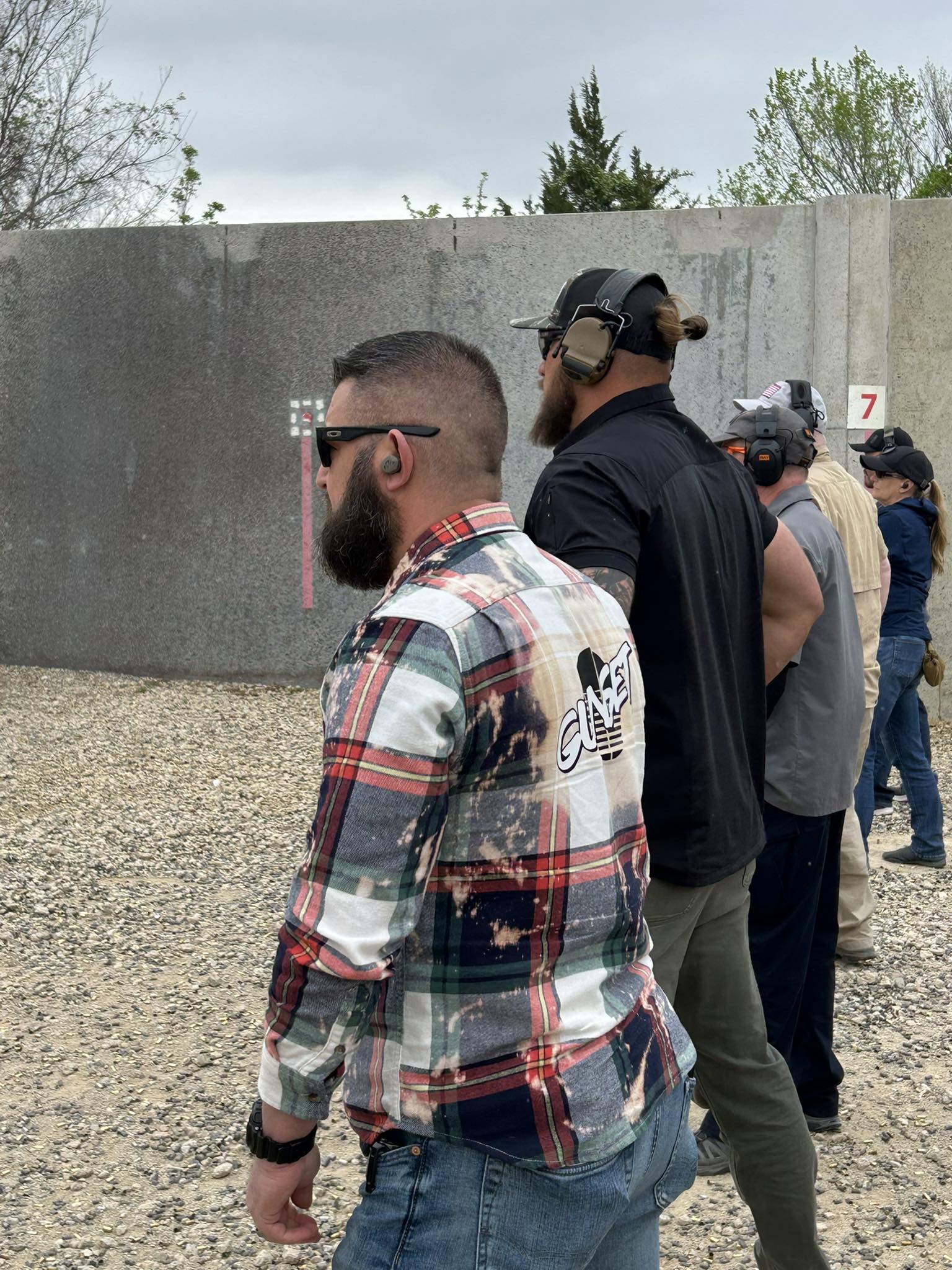
The Intro To Competition block with Tim Reedy was a fun opportunity to shoot an IDPA stage, a steel challenge stage, and then the IDPA 5×5 qualifier. The IDPA stage had 7 targets, most of which were partial targets, some of which were headshot only. The stage also included a mandatory reload, and required initial movement to the shooter’s left to engage three targets, two full value and one partial, then move to the right while reloading and engage four targets, one full value and three partials. My raw score was decent, but I nicked a no-shoot target, so that penalty dropped my score to a pedestrian 14/30.
The Steel Challenge stage was five targets, with the stop plate in the middle of the array. I chose to engage the targets in the 1, 2, 5, 4, 3 order and wound up 5/31. Considering who some of the other shooters in the class were, I was thrilled to come out 5th.
We then moved to the IDPA 5×5 classifier. The classifier is a simple, standardized course of fire used to compare all IDPA shooters across the country against each other. The course of fire is simple, with all 25 rounds fired from 10 yards, all to one IDPA target:
- Draw from concealment, fire 5 rounds to the body freestyle
- Draw from concealment, fire 5 rounds to the body strong-hand only
- Draw from concealment, fire 5 rounds to the body freestyle, reload, fire 5 rounds to the body freestyle
- Draw from concealment, fire 4 rounds to the body and 1 round to the head freestyle
If you’re curious how you compare to competitive shooters, it’s a good classifier to run through occasionally. A couple of notes on the classifier: first, there is a difference between shooting the classifier using official targets with non-visible scoring zones vs using targets with visible scoring rings. Shooting targets with no visible features requires significantly more mental and visual focus. Second, shooting any drill or qual in front of a class of your peers (and far superiors) with the instructors watching you, knowing that you only get one shot, adds a significant amount of stress and pressure. It always highlights that you don’t rise to the occasion; you sink to your lowest level of training. Having said that, out of the 12 people that shot the classifier, I finished 4th, with only 1 shot outside the (non-visible) 8″ prime scoring zone, for a final score of 23.51 (Sharpshooter class). I’ve shot the 5×5 quite a few times; this wasn’t my best run (I frequently shoot Expert class), but those runs were not under the same circumstances. While the raw numbers say this was one of my better, but not best, runs, given the situation, I consider it my new personal best.
The Pistol Match
Everyone who attends TacCon is automatically entered into the pistol match, though not everyone shoots it. This year, 250 people (a little over half) shot the match. Rangemaster (the TacCon organizers) ask that people not divulge the details of the match, so I won’t list the exact course of fire. The match changes year-to-year, but there are still some similarities, and they do not want the match to be something that people practice for. The idea is that you show up and solve the problem you’re presented with, similar in concept to a defensive encounter. Bring the general skills you have, and apply them the best you can, without trying to game the system. The match is broken into two courses of fire. The first uses turning targets, which face the shooter for a set amount of time before turning away. The facing-time is the same for all the strings of fire in the first course. A total of 40 rounds were fired in the first course, from distances of 3 yards out to 10 yards. Most of the strings involved drawing from concealment, with a few starting from low ready. Likewise, most strings were shot freestyle, with a few shot either strong or support hand only. This course is not particularly difficult, though I did miss one support-hand-only shot and scored 198/200 points.
The second course of fire in the match is basically the tie-breaker phase. This phase is much shorter, just 6 rounds this year, scored using hit factor (points/time). This means you have to balance shooting accurately with shooting quickly. Getting all your hits but taking too much time will diminish your score, but so will shooting very quickly but with poor accuracy. Phase II this year was much more difficult than the past few years, using multiple small targets from a moderate distance. While the stages in the Intro to Competition class were more or less for fun (though we were keeping score, of course), the pistol match has a little more riding on it. There are a lot more people shooting the match, including some of the best shooters in the world, the scores are posted on the final day at the range and on the Facebook group, the top 16 men and top 8 women go into the playoffs, and of course, a winner is crowned at the end. You want to do your absolute best, but you only get one shot. Either stand and deliver or fold under the pressure.
To top things off, Sean Martin, one of the top shooters in the nation, and the eventual match winner, was shooting right next to me. Watching him shoot the tiebreaker clean in an absurdly fast time was very humbling, though also totally expected. Seeing a performance like that right before your turn can get in your head a bit. You want to beat the best, but if you’re not careful, you start to get outcome-focused rather than process-focused. I wanted to go toe-to-toe with the best shooter at TacCon, but I also knew I’m simply not that good. So, rather than focus on the outcome, I focused on the process and let the score fall where it may. When the smoke cleared, I shot the tie breaker clean and did it in what I considered to be a very good time for me. I wound up 37th out of 250, which is a significant improvement over my standing last year. I’ve put in a lot of work over the past year to improve all the aspects of shooting, and the match results indicate the work has been paying off.
Parting Shots
The Intro To Competition block was a lot of fun and a good chance to shoot some dynamic, competitive stages. And as always, the pistol match was a great opportunity to get the heart rate and stress up and test myself against some of the best shooters I’ve ever seen. While the training and learning are the most important and best parts of TacCon, it never hurts to throw a little competition into the mix.
Train under pressure.

